Rakuten posts hundreds of open roles across Tokyo, Paris, and San Mateo. Most of the job descriptions bury their real requirements at the bottom of the listing, past three screens of corporate boilerplate.
That buried detail problem trips up a lot of candidates. A role titled “Marketing Specialist” might quietly require business-level Japanese or a specific cloud tool certification near the final paragraph.
This breakdown is for remote-ready professionals already comfortable with distributed work who want to break into a global tech operation without wasting applications on roles they never qualified for.
Rakuten’s Careers Portal Is the Only Door That Matters
Every major company says “apply on our website,” and candidates still scatter applications across Indeed, ZipRecruiter, and random LinkedIn reposts. Rakuten’s situation makes the official portal more important than usual.
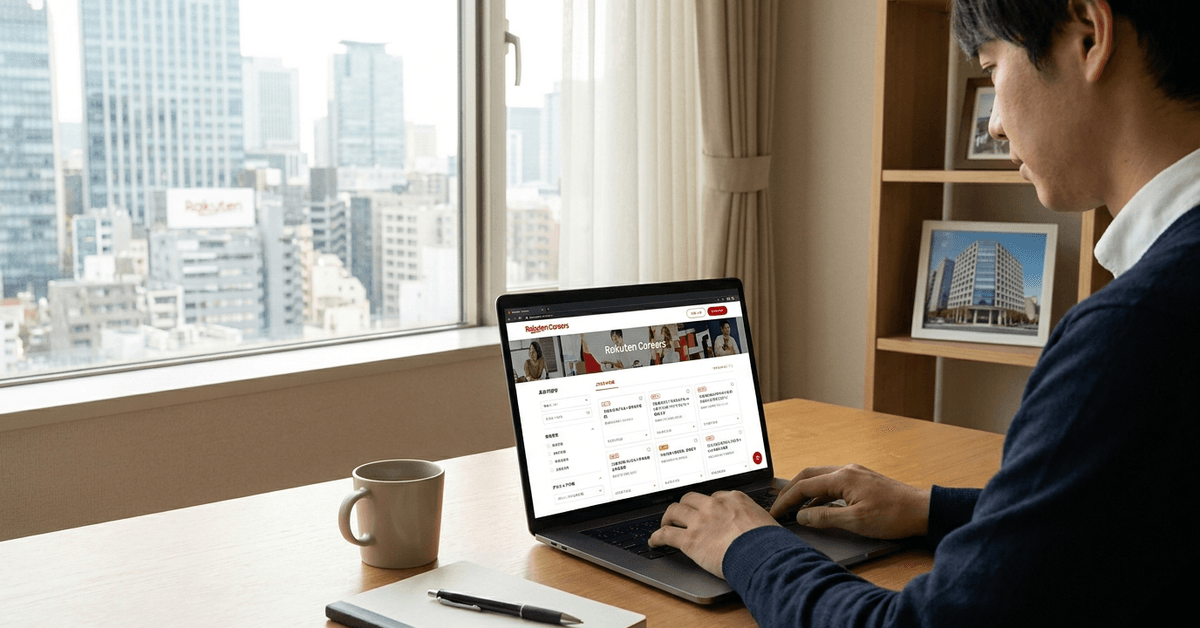
The company processes international applications through Rakuten Careers exclusively for most global positions, and third-party boards frequently carry outdated listings with closed deadlines or changed requirements.
Setting Up a Candidate Profile
The portal asks for a name, email, and CV upload. That’s the minimum. But the profile also lets you save roles and set alerts by department, location, or employment type.
I’d recommend setting alerts for two or three departments rather than one, because Rakuten frequently cross-lists similar roles under different teams.
A “data analyst” position in marketing and another in business operations might share 80% of the same job description.
Filtering Roles That Match Your Language Skills
One filter most candidates skip: language. Rakuten lists roles in both English and Japanese on the same portal, and some positions appear twice in different languages. Scanning both language versions of a listing can reveal different detail levels.
The Japanese-language version of a Tokyo-based role sometimes includes team size, reporting structure, or specific tool requirements that the English translation leaves out.
What Rakuten Looks for in Online Applications
The application itself follows a fairly standard format: resume, cover letter, and sometimes portfolio samples for design or technical roles. The less obvious part is what separates a screened-in application from one that disappears into an automated filter.
Resume Keywords Pulled Straight from the Listing
Rakuten’s HR process starts with either a human screen or an automated system. Both respond to keyword matching. Pulling exact phrases from the job description into your resume matters more than rewriting your entire work history.
If the listing says “cross-functional collaboration,” that exact phrase should appear somewhere on page one. I think the widespread advice to write a unique, personalized cover letter for every Rakuten application is a waste of effort for most candidates.
A strong, keyword-matched resume paired with a short, clean cover letter does more than a beautifully written two-page narrative that never gets past the filter. My take is that a 90-second cover letter focused on three matching qualifications beats a polished essay every time at this stage.
Portfolio and Code Samples for Technical Roles
Software engineering, IT architecture, and design roles often require work samples beyond the resume. Rakuten’s listings specify this when it applies, but candidates sometimes miss it because the requirement sits below the fold of the job description.
Technical candidates should prepare a curated portfolio or GitHub link before starting any application, since assembling samples after finding a listing costs days of delay.
Language Proficiency Requirements Vary More Than Expected
Not every Rakuten role requires Japanese. Global positions in customer support, marketing, and data science frequently list English as the sole language requirement.
But roles based in Tokyo or tied to Japanese market operations often require conversational or business-level Japanese, and the listing may not make the level clear. Checking the specific proficiency expectation for each role saves wasted effort.
Rakuten’s Hiring Process After the Application
Once submitted, applications move through a multi-stage pipeline. The stages are consistent enough to prepare for, though the timing between them is less predictable.
The standard sequence looks like this:
- Application review by HR or an automated screening system
- Introductory interview conducted over video call or phone
- Skills or technical assessment for engineering, data, and some marketing roles
- Manager panel interview that often includes practical scenario questions
- Background and reference checks with variable timing depending on the role and location
Some candidates report hearing back within two weeks. Others describe waits of four weeks or longer.
Communication during the process tends to be professional but thin on specifics, so expecting detailed status updates between stages may lead to frustration.
The Video Interview Stage
The introductory interview is usually the first human contact. Rakuten interviewers often ask about experience with distributed teams, comfort with asynchronous communication, and familiarity with the company’s product ecosystem.
Knowing that Rakuten operates across e-commerce, fintech, mobile, and digital content gives you a wider range of examples to draw from than treating it like a single-product company.
Panel Interviews and Practical Scenarios
The manager panel stage can include scenario-based questions. A marketing candidate might be asked to outline a campaign strategy on the spot. A technical candidate might walk through a system design problem.
These panels test how candidates think under mild pressure, and they tend to value structured reasoning over polished delivery.
Remote, Hybrid, or On-Site: How Rakuten Structures Work Arrangements
Rakuten offers remote and hybrid options for many roles, but the split varies by team and function. Operations, site management, and some customer support positions still require on-site presence in specific offices.
| Work Arrangement | Typical Roles | Locations |
|---|---|---|
| Fully remote | Data science, some marketing, software engineering | Global |
| Hybrid | Customer support, business operations, finance | Tokyo, San Mateo, Paris |
| On-site required | Site management, warehouse operations, local partnerships | Office-specific |
The takeaway: a role labeled “flexible” at Rakuten can mean anything from three office days per week to full remote, so confirming the exact arrangement during the first interview prevents surprises later.
Mistakes That Quietly Kill Rakuten Applications
Candidates applying to global companies often repeat the same errors. Rakuten’s process has a few specific traps worth knowing.
- Applying through unofficial job boards that carry expired listings or redirect to phishing sites disguised as Rakuten portals
- Ignoring the bottom half of job descriptions where language requirements, certifications, and tool proficiencies are listed
- Submitting a generic resume without matching the specific terminology used in the Rakuten listing
- Skipping the candidate profile setup on the careers portal and missing alert notifications for new postings
One less obvious mistake: treating Rakuten like a single entity. The company runs e-commerce, fintech, mobile services, and digital content operations.
A candidate applying to Rakuten’s fintech arm with only e-commerce experience may not realize the teams operate with very different technical stacks and hiring expectations.
Staying Safe During the Rakuten Job Search
Job scams targeting applicants of large international companies are common in 2026. Rakuten’s official careers portal uses standard data protection practices compliant with GDPR, and legitimate application forms never ask for banking details or government ID numbers during the initial application.
If a site claiming to be Rakuten asks for sensitive financial information before an interview, that is not their process. Sticking to the official portal and verifying any outreach against Rakuten’s corporate site keeps applications secure. LinkedIn and Glassdoor sometimes link directly to Rakuten listings, but double-checking the destination URL before entering personal details adds a layer of protection.
Rakuten also runs hiring events and talent webinars posted on their careers platform. These can be a faster route to a real conversation with a recruiter than cold-applying through the portal alone.
Questions People Ask About Rakuten Jobs Online
These questions come up repeatedly among candidates researching Rakuten careers.
- Q: Can I apply to multiple Rakuten positions at the same time?
The careers portal does not block multiple applications. Applying to two or three closely matched roles is reasonable, but submitting dozens of applications across unrelated departments may flag your profile as unfocused during the screening stage. - Q: Does Rakuten sponsor work visas for international candidates?
Visa sponsorship depends on the role, location, and the candidate’s qualifications. Tokyo-based positions have historically offered sponsorship for technical roles, but this is confirmed during the offer stage, not during initial screening. Asking about it during the first interview is normal. - Q: How competitive are entry-level Rakuten positions?
Competition for junior roles tends to be steep, particularly in software engineering and data science. Candidates with even one internship or freelance project in a related field have a measurable edge over those applying with academic credentials alone. - Q: Are Rakuten salaries competitive compared to other global tech companies?
Compensation varies widely by role and region. Tokyo-based positions follow Japanese market norms, which often include lower base salaries offset by structured bonuses and benefits. San Mateo and European roles tend to align closer to local tech industry ranges. - Q: Does Rakuten hire freelancers or contractors?
Some teams bring on contractors for project-based work, especially in content, translation, and software development. These roles appear less frequently on the main careers portal and may surface through recruitment agencies or direct team outreach instead.
Conclusion
Rakuten’s hiring process rewards candidates who read every line of a job listing before clicking submit.
The official careers portal at jobs.rakuten.careers remains the safest and most current source for open positions. Treating each application like a targeted pitch to a specific team gets better results than volume-based applying.
A few minutes spent matching your resume language to the listing language can separate your application from hundreds of generic ones.